Study Finds Women Rated More Attractive.

A major international study has found that women’s faces are consistently rated as more attractive than men’s faces, even by other women. Researchers say the finding confirms the existence of a global “gender attractiveness gap.”

Scientists analysed more than 1.5 million facial attractiveness ratings collected from 52 studies across 76 countries. The research included nearly 30,000 participants who rated around 17,000 faces from different cultures and age groups.

According to the study, female faces received higher attractiveness scores across almost every category. Researchers found that women themselves gave the highest ratings to other women, while male faces generally received lower ratings.

The study also discovered that the attractiveness gap becomes smaller with age. By around 80 years old, the difference between how male and female faces are perceived almost completely disappears.

Researchers believe facial structure may partly explain the results. On average, women tend to have rounder facial features, while men often have more rectangular face shapes. Both male and female participants showed a preference for rounder faces.

Charles Darwin previously argued that sexual selection shaped physical appearance differently across species. However, scientists continue debating why humans show such strong preferences for female facial features.

The research team, led by Eugen Wassiliwizky, says the findings appear across cultures and sexual orientations, suggesting the effect may extend beyond social or cultural influences.

Experts caution that the study does not fully explain why female faces are generally rated more attractive. However, researchers believe both biology and long-term evolutionary factors may contribute to the pattern.

Swiss Study Shows Wars Can Alter Groundwater and Water Systems

A new Swiss academic study has revealed that armed conflicts can significantly alter underground water systems and groundwater dynamics, reshaping how water resources behave in war-affected regions.

Research conducted at the University of Neuchâtel shows that large-scale population displacement and abandoned agricultural activity can directly influence groundwater recharge patterns.

Doctoral researcher Saeed Mhanna observed unexpected changes in an underground water system in a Syrian river basin, using satellite-based InSAR technology to study areas that are otherwise inaccessible due to ongoing conflict.

The findings suggest that when populations are forced to leave farmland during war, the cessation of irrigation allows groundwater levels to partially recover. In some locations, the soil surface even rose by up to 4 cm per year due to changes in underground pressure.

The study highlights how the invisible nature of aquifers makes wartime water assessment extremely difficult, especially when field access is restricted. Satellite data and indirect measurement techniques were therefore combined to analyze changes in water storage and recharge.

Beyond Syria, the research also examined the impact of the Kakhovka dam collapse in Ukraine in 2023. The study found that the destruction of the dam drastically disrupted the regional hydrological system along the Dnieper River.

Researchers estimate that the volume of water lost to the Black Sea after the dam’s collapse was roughly equivalent to the capacity of Lake Geneva, though with a significant margin of uncertainty.

The study demonstrates that modern satellite monitoring can play a crucial role in identifying damaged water infrastructure, tracking groundwater depletion, and detecting unexpected water recovery in conflict zones.

Experts say these insights could help governments and aid organizations prioritize emergency repairs, protect critical water infrastructure such as wells and pipelines, and improve humanitarian response in war-affected regions.

The research highlights the growing importance of space-based environmental monitoring in understanding how human conflicts reshape natural water systems over time.

Switzerland Ranks 3rd Globally in R&D Intensity

Switzerland continues to strengthen its position as a global innovation hub, with major companies ranking among the world’s top investors in research and development (R&D), according to a new EY study published on Tuesday.

The analysis of the world’s 500 largest corporate R&D spenders shows that Swiss firms achieved the third-highest research intensity globally in 2025, measured by the ratio of R&D spending to revenue. Only companies in the United States and the Netherlands ranked higher.

Swiss corporations recorded an average R&D intensity of 8.4%, significantly above the European average of 6.7%, although still below the United States, which leads with 9.2%.

In total, Swiss companies invested approximately €34 billion (CHF 31.2 billion) in innovation last year, placing Switzerland sixth worldwide in total R&D expenditure.

The study highlights the strong contribution of Basel-based pharmaceutical giants. Roche remains one of the world’s leading investors in innovation, spending €14.3 billion on R&D. Novartis also plays a key role, investing €9.9 billion and ranking among the top global companies.

According to EY analysts, medicines continue to be the most research-intensive industry worldwide, reflecting the importance of pharmaceutical innovation in Switzerland’s economy.

However, the report also highlights a growing gap between Europe and the United States. While American companies increased R&D spending by 12% in 2025, European firms saw only a 5% increase, with relatively stagnant revenue growth.

At the global level, technology giants dominate absolute R&D spending. Companies such as Amazon, Alphabet (Google), and Meta (Facebook) lead the rankings, with Amazon alone investing more than €96 billion, largely driven by artificial intelligence development.

EY concludes that global companies are prioritising innovation more than ever, with R&D budgets growing faster than overall revenues. This trend reinforces the importance of research investment in maintaining long-term competitiveness.

WSL Study Outlines Five Possible Futures for Switzerland

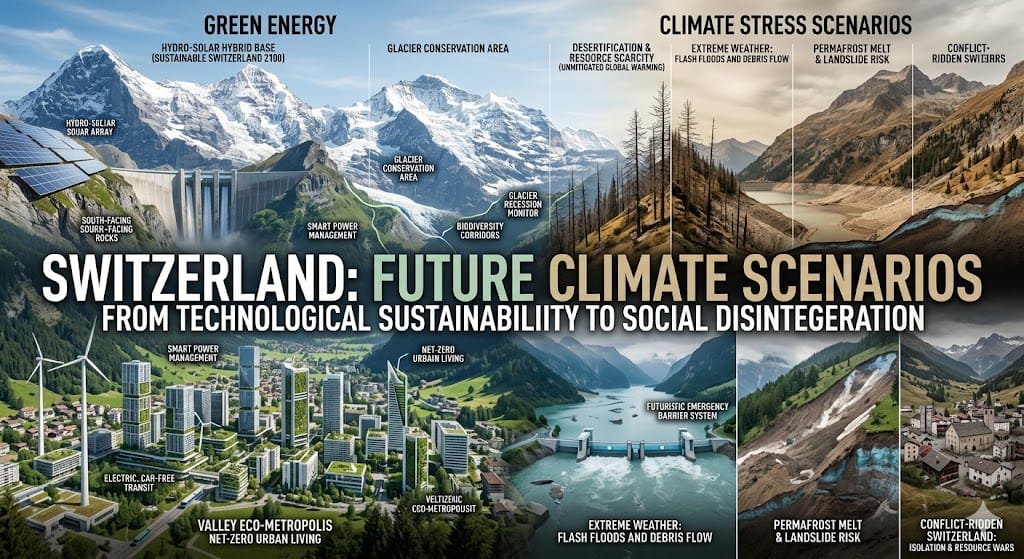
Researchers at the Swiss Federal Institute for Forest, Snow and Landscape Research have developed five possible future scenarios for Switzerland, exploring how society, the economy, and the climate could evolve by the year 2100.

The study highlights that it is impossible to predict Switzerland’s exact future. However, understanding different development paths is crucial because social, political, and economic changes directly affect resource use, infrastructure, and climate impact.

To build these scenarios, researchers collaborated with around 60 scientists from 20 institutions. A computer model was used to generate consistent projections based on global climate frameworks developed by the Intergovernmental Panel on Climate Change.

Three of the five scenarios are based on global Shared Socioeconomic Pathways, ranging from a highly technological, renewable-energy-driven society to a fragmented future marked by inequality and weakened state structures.

In the most divided scenario, society splits between a wealthy elite and a disadvantaged majority, while another scenario predicts long-term reliance on fossil fuels, resulting in severe environmental damage and high economic costs later in the century.

Two additional Switzerland-specific scenarios were also developed. One describes a country that prioritizes economic growth through fossil fuels before facing environmental consequences. The other focuses on social cohesion and well-being over pure economic expansion.

Lead researcher Lena Gubler emphasized that none of the scenarios are considered more likely than the others. Instead, they are designed as “if-then” models to explore possible outcomes rather than predict the future.

The National Centre for Climate Services (NCCS) has also released new data showing projected greenhouse gas emissions for each scenario up to 2100, providing a foundation for long-term climate planning and policy decisions.

Study Links Childhood Bullying to Conspiracy Beliefs

A long-term study in Zurich has found that childhood bullying can significantly increase the likelihood of believing in conspiracy theories later in life. Researchers say early experiences of mistrust and emotional stress can shape how individuals view the world as adults.

The study, known as the Zurich Project on Social Development from Childhood to Adulthood, has followed around 1,500 participants since 2004. Conducted by the University of Zurich and supported by the Swiss National Science Foundation, the research tracks individuals from age seven into adulthood.

According to Hanne Duindam, people who experience bullying during childhood may develop a worldview shaped by fear and mistrust. These individuals are more likely to see the world as dangerous and believe in hidden plots or conspiracies.

The findings show that participants who suffered higher levels of bullying and emotional distress were more prone to conspiracy thinking and even extremist attitudes by the age of 24. The results were published in the Journal of Youth and Adolescence.

Researchers emphasize that these beliefs should not be dismissed as irrational without understanding the underlying experiences. Instead, they highlight the importance of empathy and context when addressing such views.

The study also offers hope. Some individuals who lost trust early in life were able to recover over time, showing that intervention and support can make a difference.

Experts recommend strengthening mental health support systems in schools and families to prevent long-term psychological effects. Promoting safe environments and emotional well-being during childhood could help reduce susceptibility to harmful beliefs later in life.

Zurich Study Shock: Orphanage Children Live 12 Years Less

A new study from University of Zurich has revealed concerning long-term effects on individuals who grew up in childcare institutions in Switzerland.

According to the research, people who were placed in orphanages during childhood—particularly in the 1950s—lived on average up to 12 years less than those raised in family environments.

Researchers highlight that the primary cause behind this difference is not physical care, but emotional deprivation. Although children in institutions received adequate medical attention and basic physical care, they lacked stable emotional bonds, affection, and consistent developmental support.

In many cases, children spent most of their day alone, with limited interaction with caregivers—sometimes less than one hour per day. This isolation was largely due to institutional practices aimed at preventing disease transmission.

The study analyzed data from 830 individuals. More than half of the participants had grown up in childcare institutions between 1958 and 1961, while the rest were raised in family settings.

Findings showed that premature deaths before the age of 40 were approximately twice as common among those raised in institutions compared to those raised in families.