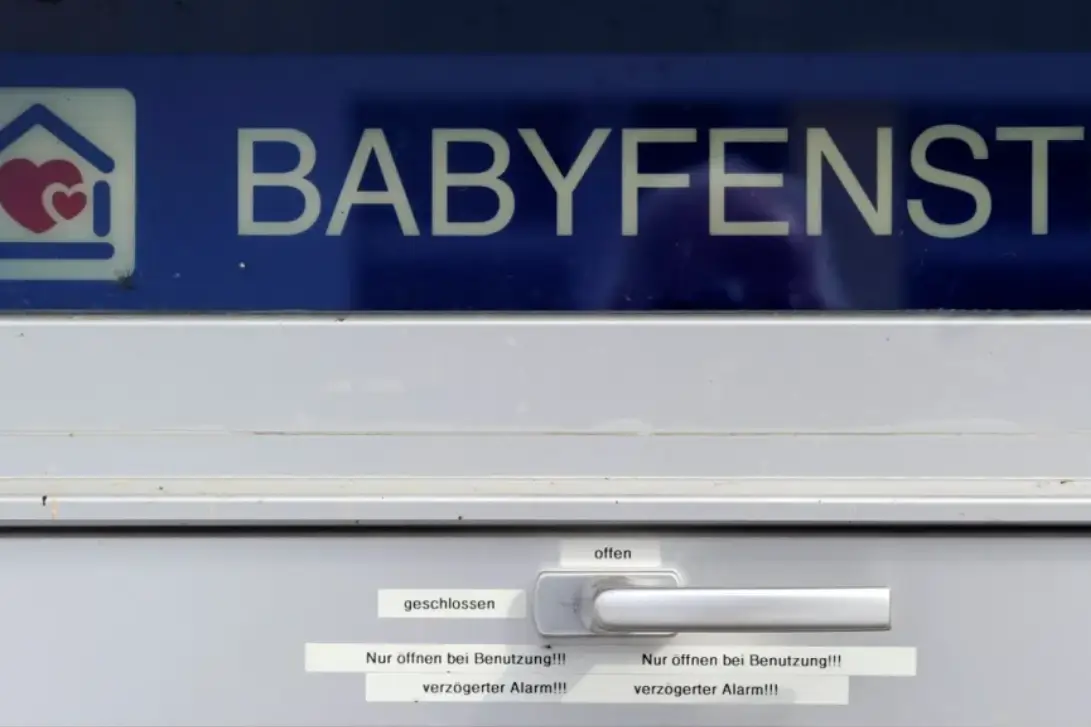
Switzerland Marks 25 Years of Baby Hatches, 31 Newborns Safely Left.

Swiss Organisation for Mother and Child marked the 25th anniversary of Switzerland’s first baby hatch on Saturday, highlighting its long-term impact on child protection and safe anonymous birth options.

The first baby hatch in Canton Schwyz opened at Einsiedeln Hospital on May 9, 2001, following the tragic discovery of two abandoned newborns in 1999 in different parts of Switzerland.

Since its introduction, baby hatches—also known as “baby boxes”—have allowed mothers in extreme distress to safely and anonymously place newborns into medical care.

The system uses a heated cot installed in a hospital wall. Once a baby is placed inside, a silent alarm alerts medical staff within minutes, ensuring immediate care.

Over the past 25 years, 31 newborns have been safely left at eight baby hatch locations across Switzerland.

Hospital staff, including midwives, take responsibility for the newborns immediately after alert activation. The babies are then placed in foster care within days.

Adoption can take place after at least one year, while biological parents retain the right to reclaim their child until legal adoption is completed.

The foundation noted that before the introduction of baby hatches, Switzerland recorded several cases of abandoned or deceased newborns. Between 1997 and 2001, there were 13 such cases.

However, in the last five years (2021–2026), no cases of newborn abandonment or infanticide have been recorded in the country, according to the foundation.

Supporters say baby hatches provide a life-saving alternative in crisis situations, while critics continue to debate legal and ethical implications.

Despite the debate, the system is considered an important part of Switzerland’s child protection framework and has inspired similar initiatives in other countries.


Comédie de Genève Removes Artistic Director Séverine Chavrier Amid Controversy

Comédie de Genève has officially dismissed its artistic director Séverine Chavrier amid growing controversy surrounding the theatre’s management and workplace environment.

The decision was announced on Friday by the Fondation d’art dramatique, which confirmed that it had ended its professional relationship with Chavrier after a majority vote by the foundation’s board.

The board meeting took place shortly after Philippe Juvet was elected as the new chairperson earlier this week, replacing Lorella Bertani, who recently resigned from the position.

Following the decision, staff members at Comédie de Genève were informed that Chavrier would no longer continue in her role as artistic director.

The dismissal comes during an ongoing controversy linked to a human resources audit involving nearly 150 employees and collaborators connected to the theatre institution.

However, the results of the audit have not yet been publicly released after Chavrier’s lawyer, Romain Jordan, secured a legal ban preventing publication through emergency judicial measures.

In a strongly worded statement, Jordan criticised the foundation and accused it of misconduct. He claimed the institution had become “dysfunctional” and alleged that the board intended to remove his client “at any cost.”

The controversy has attracted attention across Geneva’s cultural sector, with growing debate surrounding leadership, workplace management, and governance within major Swiss arts institutions.

Comédie de Genève is one of Switzerland’s most prominent theatre venues and plays an important role in Geneva’s cultural landscape.

Observers say the dispute could have long-term effects on the institution’s reputation and future artistic direction.

Apple and Intel Sign Major Semiconductor Deal as Shares Surge.

Apple Inc. and Intel Corporation have reportedly signed a major preliminary agreement that could reshape the global semiconductor industry.

According to reports from The Wall Street Journal, discussions between the two technology giants had continued for more than a year before both sides finalized a structured framework agreement.

The exact Intel technologies and semiconductor products that will be integrated into future Apple devices remain confidential. However, industry analysts believe the partnership could significantly influence future chip manufacturing strategies and hardware development.

The agreement has already triggered strong reactions in the financial markets. Investors responded positively to the news, driving a sharp increase in stock prices for both companies.

Intel shares surged by 18.26%, reaching approximately $129.64, while Apple shares rose by 1.59% to around $292.00.

The deal also signals a strategic shift for Apple, which has previously maintained semiconductor partnerships with companies including Samsung.

Market experts say the new collaboration may help Intel strengthen its position in the global semiconductor market while allowing Apple to diversify its supply chain and chip development capabilities.

The semiconductor industry continues to play a critical role in artificial intelligence, mobile devices, cloud computing, and advanced consumer electronics, making partnerships between major technology firms increasingly important.

Investors and analysts are now closely watching future announcements to determine how the partnership will impact upcoming Apple products and the broader global chip industry.

Swiss Consumer Confidence Rises Slightly but Remains Weak

Consumer confidence in Switzerland has shown a slight improvement in April, but overall sentiment remains weak as households continue to face economic uncertainty and persistent high prices.

According to data released by the State Secretariat for Economic Affairs, the consumer confidence index rose to -40.0 points in April, up from -42.9 in March. In February, the index had already dropped sharply from -30.4, indicating continued volatility in public sentiment.

Despite the monthly improvement, the index remains below the long-term average of -37.5, highlighting ongoing economic concerns among Swiss households.

On a year-on-year basis, consumer confidence improved slightly by 2.4 points, but expectations for the future remain cautious.

A key driver of the slight improvement is the better perception of the overall economic outlook. The sub-index measuring expected economic development rose from -67.9 to -58.0 in April.

However, this figure is still far below its long-term average of -33.6, showing that consumers remain pessimistic about future economic growth.

Experts note that job insecurity, inflationary pressure, and high living costs continue to weigh heavily on household sentiment.

While some stabilization is visible, economists caution that consumer confidence in Switzerland is still fragile and could be affected by global economic conditions, interest rate changes, and geopolitical uncertainty.

Swiss Government Responds to Epstein Property Questions.

The Switzerland government says it cannot confirm whether late American financier Jeffrey Epstein owned property in Switzerland.

The statement came in response to a parliamentary inquiry submitted following growing attention on Epstein’s alleged Swiss connections revealed in recent months.

In its official response, the Swiss Federal Council stated that it has “no knowledge” of any property purchases made by Epstein in Switzerland. However, authorities also acknowledged that they cannot completely rule out the possibility.

The government explained that oversight of foreign property purchases falls under the responsibility of individual Swiss cantons rather than federal authorities.

Swiss officials remained cautious when responding to additional parliamentary questions related to Epstein’s activities and potential financial links within Switzerland.

Interest in Epstein’s international network intensified after United States authorities released approximately 3.5 million declassified pages connected to investigations involving the convicted sex offender, who died in prison in 2019.

According to multiple media reports, Epstein allegedly financed educational opportunities for several young women in Switzerland and maintained connections with influential figures in international finance.

The revelations have renewed public and political discussions about financial transparency, oversight of international wealth, and Switzerland’s historical links to high-profile global figures.

Swiss authorities have not announced any criminal investigation related to the reported property questions.

The case continues to attract international attention due to Epstein’s extensive network of global contacts and the ongoing release of previously classified information connected to his activities.