

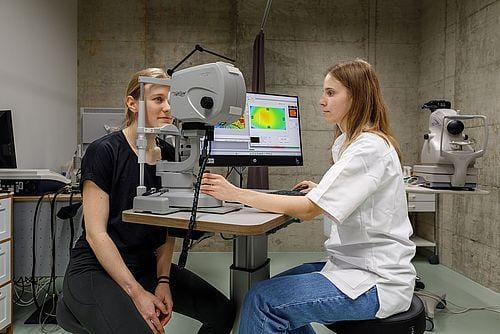

Swiss Scientists Discover New Target for Treating Blindness.
Researchers led by the University of Fribourg in Switzerland have identified a promising new biological target that could lead to improved treatments for age-related macular degeneration (AMD), one of the leading causes of blindness worldwide.
The study focuses on restoring the eye’s natural cellular recycling system, which plays a critical role in maintaining retinal health. Scientists believe that failure in this system is a key driver of vision loss as people age.
AMD primarily damages photoreceptors and retinal pigment epithelial cells, which are essential for clear central vision. When these cells deteriorate, patients gradually lose the ability to see fine details, significantly affecting daily life.
The Swiss research team, led by experts in cellular biology, investigated a process known as chaperone-mediated autophagy (CMA). This system normally helps cells remove damaged proteins and maintain internal balance, but it becomes less effective with age.
According to the findings, CMA activity is crucial for retinal health, and its breakdown may directly contribute to the development of AMD. By identifying this mechanism, researchers have uncovered a potential “control point” for future therapies.
The study also explored an experimental molecule known as CA77.1, which was designed to reactivate the cell’s waste-clearing system. In laboratory models, activation of this pathway reduced inflammation and slowed cellular degeneration linked to vision loss.
Tests on cells derived from AMD patients showed improved cellular stability when the recycling mechanism was strengthened. Scientists say this suggests a new direction in treatment strategies that focus on restoring natural cell function rather than only managing symptoms.
Age-related macular degeneration affects millions globally, with risk increasing significantly after the age of 50. In older populations, the disease becomes a major cause of irreversible central vision loss, creating an urgent need for innovative therapies.
Researchers believe that targeting cellular aging mechanisms could open the door to future treatments that preserve or even restore vision. While the findings are still in early stages, they represent a significant step forward in ophthalmology research.
Switzerland continues to strengthen its position as a leading hub for medical and life sciences innovation, with this study offering new hope for addressing age-related blindness in the future.