

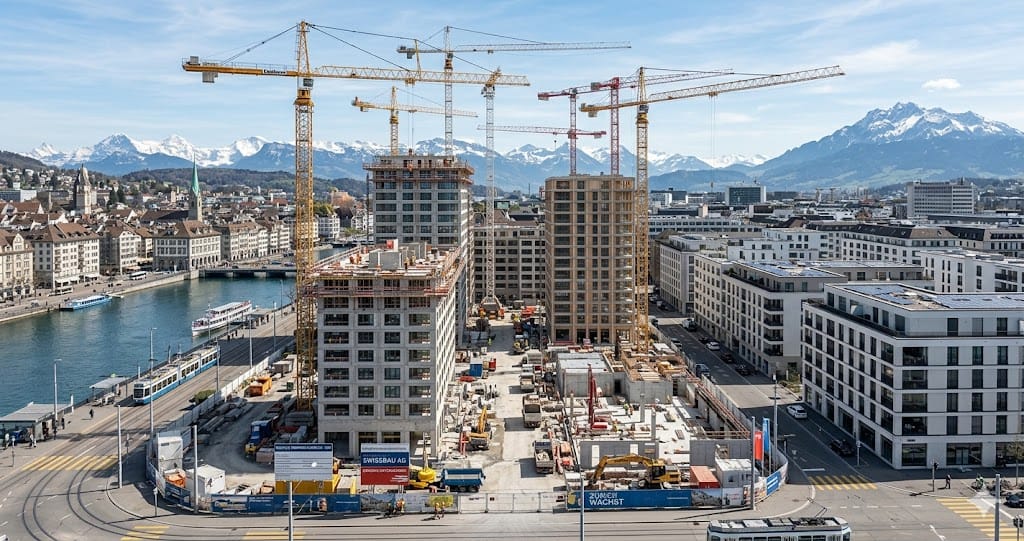
Swiss Construction Growth Driven by Housing Demand.

The Swiss construction industry started 2026 with strong growth, driven mainly by rising residential property demand across the country.

According to the Swiss Builders Association, total activity in building construction and civil engineering increased by 5.6% to CHF 4.98 billion between January and March 2026. Residential construction recorded the strongest performance, rising by 7.4% during the same period.

The growth is supported by sustained demand for new housing projects. Low interest rates and limited housing availability continue to encourage residential development across Switzerland.

However, civil engineering growth remained weak, increasing by only 0.1%. The public sector reduced investment activity, which slowed overall infrastructure development. Rising material costs, particularly bitumen prices influenced by global geopolitical tensions, also added pressure to the sector.

The Swiss Builders Association expects the second half of 2026 to grow at a slower pace. While residential construction is expected to remain stable, civil engineering may face uncertain conditions due to external economic and political factors.

Despite global challenges, supply chain conditions have improved significantly. Only 6% of construction companies currently report material shortages, compared to nearly 50% during the post-Ukraine war disruption period.

Overall, Switzerland’s construction sector remains stable, with housing demand continuing to be the key driver of growth.

Swiss Economy Grows 0.5% Despite Oil Price Shock

The Swiss economy recorded stronger-than-expected growth in early 2026 despite global pressure from rising oil prices and ongoing trade uncertainties.

According to a flash estimate released by the State Secretariat for Economic Affairs (SECO), Switzerland’s gross domestic product (GDP) increased by 0.5% in the first quarter of 2026 compared to the previous quarter.

Both the industrial and service sectors contributed to this positive performance, showing resilience even amid external economic shocks.

The growth rate exceeded analysts’ expectations, which had predicted expansion between 0.3% and 0.4%, according to market surveys.

In the previous quarters, the Swiss economy showed mixed performance, including a 0.2% growth at the end of 2025 and a 0.5% contraction earlier due to tariff-related tensions.

SECO officials noted that improved business confidence played a key role in the recovery, along with easing tariff pressures and modest positive spillover effects from Germany’s economy.

However, economists remain cautious about the outlook. Rising oil prices, which increased significantly in March, could still affect economic momentum in the coming months.

Despite this, confidence indicators have remained relatively stable, suggesting that short-term growth may continue.

The Swiss government currently projects annual growth of around 1.0%, though this could be revised down to 0.8% if high energy prices persist.

A detailed GDP breakdown is expected in the upcoming full report scheduled for June 1, which will provide deeper insight into sector-specific performance.