


Lowest Mortgage Rates in Switzerland 2026.

Switzerland continues to offer competitive mortgage options in 2026, with several banks and financial providers providing relatively low interest rates depending on borrower eligibility, income stability, and property value.

One of the notable providers is Crédit Agricole next bank (Suisse) SA, which offers fixed mortgage rates starting around 1.38% for 5-year terms. It remains one of the competitive options in the Swiss mortgage market.

The BEKB | BCBE is also known for offering some of the lowest advertised fixed rates in the market. Reports indicate approximately 0.55% for 5-year fixed mortgages and around 0.80% for 10-year terms, although actual rates depend heavily on borrower profile, income, and down payment capacity.

Major banking institutions such as UBS provide mortgage solutions like the Key4 product, where 5-year fixed rates may start around 1.23%. Digital application processes sometimes allow customers to access more competitive offers.

Another stable option is Migros Bank, offering approximately 1.65% for 5-year fixed mortgages, widely preferred for its customer service and reliability.

In the Zurich region, Zürcher Kantonalbank remains a trusted lender with slightly higher rates around 1.8%, but it is known for easier approval processes and strong regional support.

Experts also recommend using mortgage brokers such as MoneyPark AG, Comparis Hypothekenservice (HypoPlus), and HYPOTHEKE.ch, which compare multiple banks and often negotiate better deals. In some cases, borrowers can save 0.2% to 0.5% compared to direct bank offers.

Current Market Overview (2026)

  • SARON mortgages: 0.9% – 1.3%
  • 5-year fixed: 1.2% – 1.6%
  • 10-year fixed: 1.5% – 1.9%

Borrowers are advised to compare offers carefully, as final mortgage rates vary depending on financial profile, property type, and risk assessment.

Switzerland Faces Call to Scrap OECD Minimum Tax.

A new study from the University of St. Gallen (HSG) urges Switzerland to abolish the OECD minimum tax, arguing that the system is outdated, legally uncertain, and economically harmful for the country’s competitiveness.

Professor Peter Hongler from HSG’s Institute of Law and Economics stated that global conditions have changed significantly since Switzerland’s 2023 referendum approval. He emphasized that the tax no longer serves its original purpose and now creates more risks than benefits for Switzerland’s business environment.

The study highlights that Switzerland introduced the OECD minimum tax in 2024 expecting widespread global adoption. However, only around 33 countries have fully implemented the rules so far, far below the expected 140 nations.

Researchers also warn that the absence of major economies, including the United States, has weakened the global effectiveness of the policy. According to the report, the framework has shifted from a global agreement into what is effectively an EU-centered initiative.

The study concludes that Switzerland should reconsider its participation, as the current system may reduce investment attractiveness and create unnecessary fiscal and legal exposure.

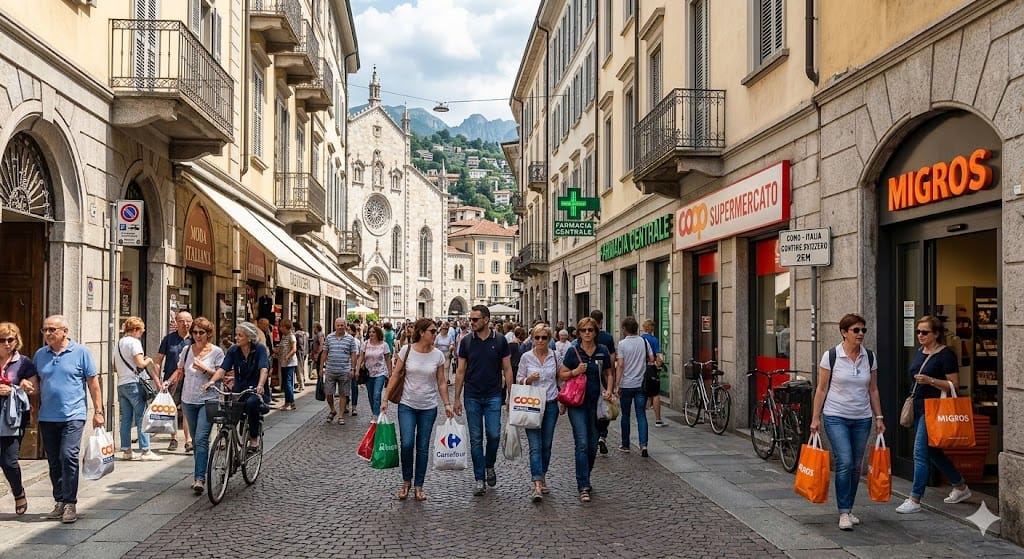
Ticino Retailers Struggle as Cross-Border Shopping to Italy Surges

Retailers in Ticino are coming under increasing pressure as cross-border shopping in nearby Italy continues to rise sharply, shifting consumer spending away from local stores.

According to industry estimates, the value of purchases made abroad by Ticino residents has grown from around Swiss Franc 500 million to CHF 700 million over the past five years. Many residents now rely heavily on supermarkets and retail outlets across the border in Italy for everyday goods.

Enzo Lucibello, president of the Ticino Association of Large Retailers (Disti), confirmed the trend, citing data reported by Corriere del Ticino and global VAT refund operator Global Blue.

A key factor behind the increase is Italy’s revised VAT refund policy. Since February 1, 2024, the minimum spending threshold for tax-free purchases has been reduced to €70, encouraging more Swiss shoppers to shop across the border.

The city of Como has seen a 6% rise in tax-free spending over the past two years, significantly above the national average. Swiss consumers account for 61% of total VAT refund spending, making them the largest group of cross-border shoppers.

Data shows that while non-EU customers tend to spend on luxury goods, Swiss shoppers primarily purchase groceries and everyday products. In fact, around one in two Swiss users of the VAT refund system shop mainly in supermarkets near the border.

The trend continues to challenge local retailers in Ticino, raising concerns about the long-term impact on the region’s domestic retail sector.