8 Things Landlords in Switzerland Are Legally Not Allowed to Ask Tenants.

Finding a rental home in Switzerland can be challenging, and tenants often feel pressured to accept strict conditions. However, Swiss tenancy law provides strong protections that clearly define what landlords can and cannot demand from tenants.

Under Swiss rental regulations, landlords are not allowed to impose or request several types of information or conditions that violate privacy, equality, or legal boundaries.

Here are 8 things landlords in Switzerland cannot legally ask tenants to provide or accept:

1. Excessive personal data

Landlords cannot request unnecessary personal details such as detailed lifestyle habits or unrelated private information beyond rental needs.

2. Religious or political affiliation

Tenants cannot be asked about their religion, political views, or ideological beliefs.

3. Ethnicity or nationality discrimination

Although identification is required, landlords cannot use nationality or ethnicity to discriminate in rental decisions.

4. Medical or health information

Landlords are not allowed to request medical history or health conditions of tenants.

5. Unreasonable financial guarantees

Demands for excessive deposits beyond legal limits (typically more than three months’ rent) are not permitted under Swiss law.

6. Permanent employment requirement without flexibility

While income verification is allowed, landlords cannot impose unrealistic employment conditions that exclude otherwise financially stable applicants.

7. Personal relationship or family planning details

Questions about marriage plans, pregnancy, or family intentions are not allowed.

8. Illegal clauses in rental contracts

Any contract terms that violate tenant protection laws—such as waiving legal rights—are not enforceable.

Swiss tenancy law is designed to ensure fairness between landlords and tenants while protecting privacy and preventing discrimination. Even in competitive housing markets, landlords must comply with strict legal frameworks.

Tenants who feel their rights have been violated can seek help from tenant associations or legal authorities in Switzerland.

Switzerland Plans Tougher Punishments for Bicycle Theft

Switzerland is preparing stricter legal measures to combat rising bicycle theft cases across the country, where nearly 50,000 bicycles are reportedly stolen every year.

The proposed legal changes have received support from the Swiss Federal Council following a proposal introduced by Lukas Reimann of the Swiss People’s Party.

Under current Swiss law, offenders can sometimes avoid serious punishment by claiming they only intended to use a bicycle temporarily. In many cases, this results in only minor fines or light penalties.

The new proposal aims to remove this loophole, especially for thefts involving expensive bicycles and e-bikes.

If approved, high-value bicycle theft would no longer be treated as a minor offence, and offenders could face stronger criminal penalties under Swiss law.

Authorities indicated that limited exceptions may still apply in specific situations, such as disputes within families or cases where previous permission to use the bicycle existed.

However, cycling advocates argue that tougher punishments alone will not fully solve the growing problem.

Experts say many Swiss cities still lack secure bicycle parking infrastructure, making bicycles easier targets for theft.

Traditional inverted-U bicycle racks often protect only the main frame while leaving wheels and other components vulnerable.

Cycling organisations point to safer systems used in cities such as New York City, where closed-loop locking stations offer better protection for the entire bicycle structure.

Advocates are calling for Switzerland to combine stronger laws with improved urban cycling infrastructure and modern secure parking facilities.

The issue has gained increasing public attention as cycling and e-bike usage continue to grow rapidly across Switzerland.

Swiss Government Responds to Epstein Property Questions.

The Switzerland government says it cannot confirm whether late American financier Jeffrey Epstein owned property in Switzerland.

The statement came in response to a parliamentary inquiry submitted following growing attention on Epstein’s alleged Swiss connections revealed in recent months.

In its official response, the Swiss Federal Council stated that it has “no knowledge” of any property purchases made by Epstein in Switzerland. However, authorities also acknowledged that they cannot completely rule out the possibility.

The government explained that oversight of foreign property purchases falls under the responsibility of individual Swiss cantons rather than federal authorities.

Swiss officials remained cautious when responding to additional parliamentary questions related to Epstein’s activities and potential financial links within Switzerland.

Interest in Epstein’s international network intensified after United States authorities released approximately 3.5 million declassified pages connected to investigations involving the convicted sex offender, who died in prison in 2019.

According to multiple media reports, Epstein allegedly financed educational opportunities for several young women in Switzerland and maintained connections with influential figures in international finance.

The revelations have renewed public and political discussions about financial transparency, oversight of international wealth, and Switzerland’s historical links to high-profile global figures.

Swiss authorities have not announced any criminal investigation related to the reported property questions.

The case continues to attract international attention due to Epstein’s extensive network of global contacts and the ongoing release of previously classified information connected to his activities.

European Court Rules Switzerland Violated Protest Organizer’s Rights.

The European Court of Human Rights has ruled that Switzerland violated the rights of a protest organizer linked to a demonstration held in Geneva in 2019.

The case involved an International Women’s Day protest that had received official authorization from local authorities. Before the event, organizers were informed that they could be held personally responsible if permit conditions were violated during the demonstration.

During the protest, riots and disturbances reportedly occurred, leading Swiss authorities to accuse the organizer of failing to maintain an effective security service.

Swiss courts later convicted the organizer under criminal law and imposed a fine of CHF200.

The organizer appealed the decision to the European Court of Human Rights in Strasbourg, arguing that her fundamental rights had been violated.

In its verdict published on Thursday, the ECHR concluded that Switzerland violated several rights protected under the European Convention on Human Rights, including freedom of assembly, freedom of association, freedom of expression, and the right to a fair trial.

The ruling represents another significant judgment involving Switzerland and human rights protections under European law.

Legal experts say the decision could influence how Swiss authorities manage public demonstrations and assess the responsibilities of protest organizers in future events.

The case also highlights the ongoing balance between maintaining public order and protecting democratic rights such as peaceful protest and freedom of expression.

The ECHR has played a major role in shaping human rights standards across Europe, with its rulings often leading member states to review legal procedures and public policies.

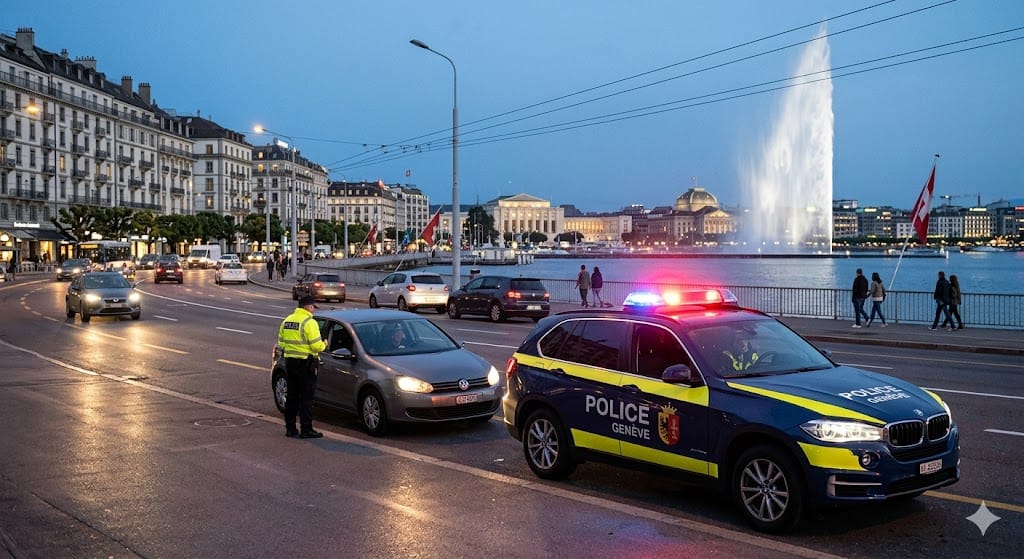
Swiss Police Stop French Customs Vehicle in Geneva

Swiss police in Geneva stopped a vehicle carrying French customs officers after noticing it was using flashing blue lights similar to an emergency police vehicle.

Authorities observed the vehicle traveling with prominent blue emergency-style lights activated, which prompted immediate action from Swiss law enforcement. The vehicle was registered in France, leading officers to conduct a detailed inspection.

During the investigation, police confirmed that the passengers were French customs officials returning from a training session held near an airport. Although they were on official duty, the use of blue flashing lights in Swiss territory without authorization violated local traffic regulations.

Swiss authorities reminded the officials that all road users, including foreign government personnel, must strictly follow Swiss traffic laws while operating within the country. The officers were issued a formal warning and allowed to continue their journey after the check.

Swiss police emphasized their strict enforcement of road safety rules, noting that even minor misuse of emergency-style signals is taken seriously to ensure public safety and order.