

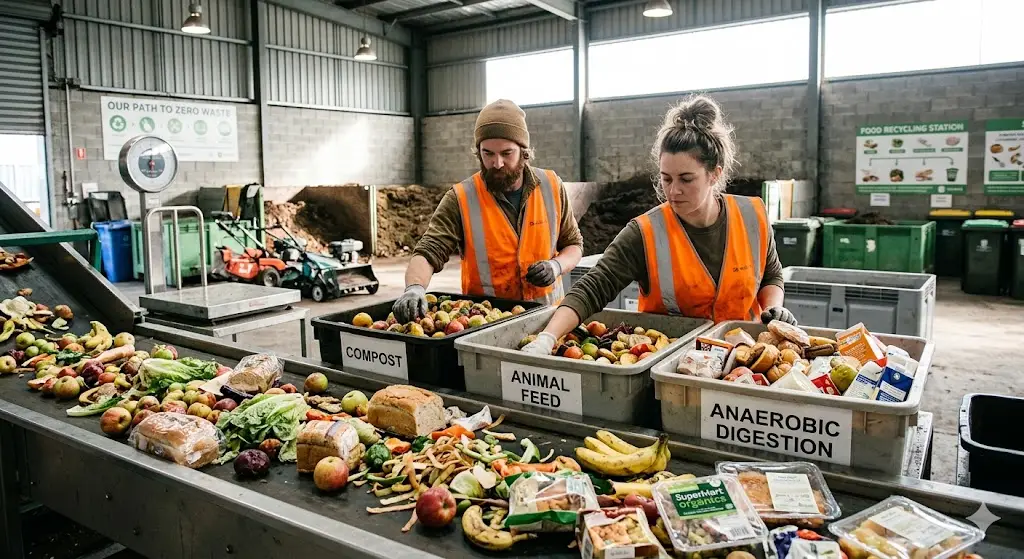
Swiss Government Warns Food Waste Remains Too High.

The Switzerland government has warned that food waste levels across the country remain far too high, despite ongoing national efforts to reduce waste by 2030.

In an interim report released on Wednesday, authorities revealed that food waste declined by only around 5% between 2017 and 2024, falling well short of the targeted 25% reduction by 2025.

Switzerland launched its national action plan against food waste in 2022, aiming to cut avoidable food losses in half by the year 2030. While some sectors have shown measurable improvement, officials say overall progress remains too slow.

The retail industry achieved the strongest results, reducing food waste by approximately 20% through improved inventory management, discount systems, and food redistribution initiatives.

However, Swiss households continue to lag behind, remaining one of the biggest contributors to unnecessary food waste. Authorities say consumer behavior, over-purchasing, and poor meal planning remain major challenges.

The government emphasized that reducing food waste is essential for environmental protection, resource conservation, and climate goals, as discarded food contributes significantly to greenhouse gas emissions.

Officials are now calling for stronger public awareness campaigns and greater cooperation between households, businesses, and food service sectors to accelerate progress toward the 2030 target.

Food waste reduction has become a major sustainability issue across Europe as governments seek to improve resource efficiency and reduce environmental impact.
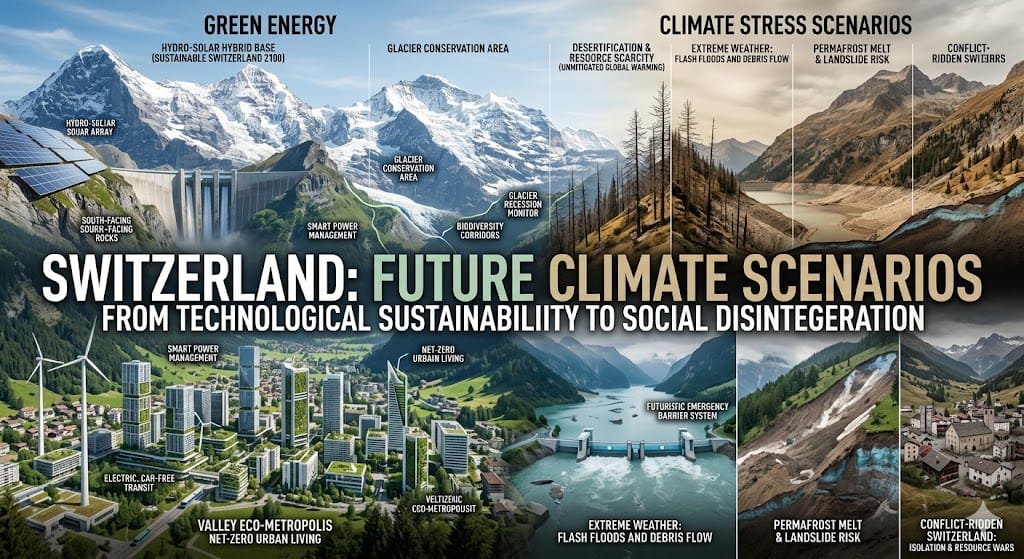
WSL Study Outlines Five Possible Futures for Switzerland

Researchers at the Swiss Federal Institute for Forest, Snow and Landscape Research have developed five possible future scenarios for Switzerland, exploring how society, the economy, and the climate could evolve by the year 2100.

The study highlights that it is impossible to predict Switzerland’s exact future. However, understanding different development paths is crucial because social, political, and economic changes directly affect resource use, infrastructure, and climate impact.

To build these scenarios, researchers collaborated with around 60 scientists from 20 institutions. A computer model was used to generate consistent projections based on global climate frameworks developed by the Intergovernmental Panel on Climate Change.

Three of the five scenarios are based on global Shared Socioeconomic Pathways, ranging from a highly technological, renewable-energy-driven society to a fragmented future marked by inequality and weakened state structures.

In the most divided scenario, society splits between a wealthy elite and a disadvantaged majority, while another scenario predicts long-term reliance on fossil fuels, resulting in severe environmental damage and high economic costs later in the century.

Two additional Switzerland-specific scenarios were also developed. One describes a country that prioritizes economic growth through fossil fuels before facing environmental consequences. The other focuses on social cohesion and well-being over pure economic expansion.

Lead researcher Lena Gubler emphasized that none of the scenarios are considered more likely than the others. Instead, they are designed as “if-then” models to explore possible outcomes rather than predict the future.

The National Centre for Climate Services (NCCS) has also released new data showing projected greenhouse gas emissions for each scenario up to 2100, providing a foundation for long-term climate planning and policy decisions.