

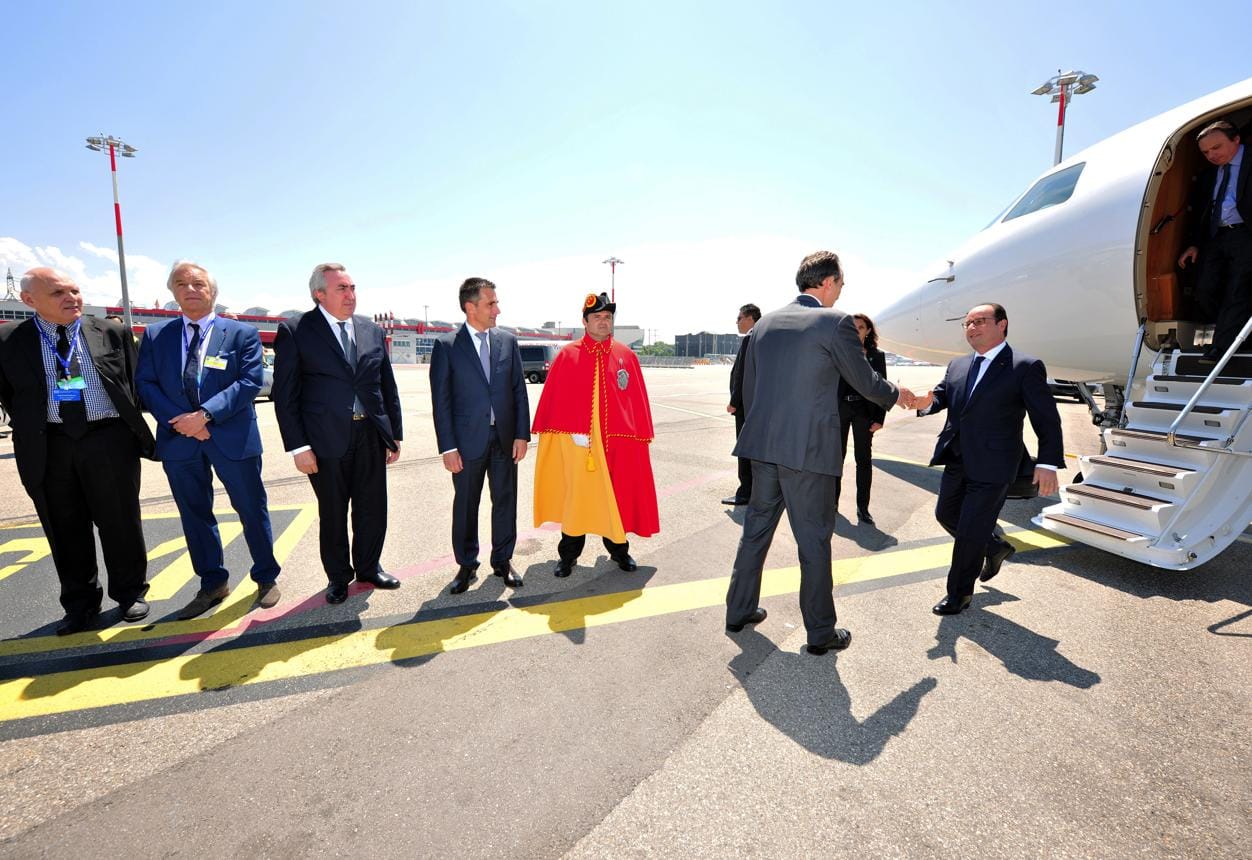
Trump Arrives in Geneva Ahead of G7 Summit

United States President Donald Trump arrived at Geneva Airport on Sunday as part of his journey to the G7 Summit taking place in Évian-les-Bains, France. The visit placed Geneva briefly at the center of international attention as world leaders gathered for one of the most important global political meetings of the year.

Upon landing in Switzerland, President Trump was welcomed by Swiss President Guy Parmelin and the United States Ambassador to Switzerland, Callista Gingrich. The arrival highlighted the close diplomatic ties between Switzerland and the United States, as Swiss officials extended an official reception to the American leader.

Trump remained on the airport tarmac only for a short period before boarding a US Navy helicopter. Live footage showed the president quickly transferring to the aircraft under tight security arrangements. The helicopter then departed for Évian-les-Bains, located on the French side of Lake Geneva, where the G7 Summit is being held.

The Group of Seven (G7) summit brings together leaders from some of the world’s largest economies to discuss global economic growth, security, trade, climate policy, and international cooperation. This year’s gathering is expected to focus on geopolitical stability, economic challenges, and emerging global security concerns.

Geneva Airport operated under extraordinary security measures during the presidential visit. Swiss authorities coordinated closely with American security services to ensure a safe and smooth transit operation. Additional security personnel, restricted-access zones, and military aircraft were visible around the airport throughout the arrival process.

Switzerland has long played an important role in international diplomacy and regularly hosts visits from global leaders due to its neutral status and strategic location in Europe. Geneva, in particular, is known worldwide as a center for diplomacy, international organizations, and high-level political discussions.

Trump’s brief stop in Geneva once again placed Switzerland at the heart of international affairs as world attention turns toward the outcomes of the G7 Summit in France.

Swiss Parliament Approves Millions for EU Research Programmes

Switzerland has reaffirmed its commitment to international scientific cooperation after both chambers of Parliament approved CHF58.3 million in funding for European Union research programmes. The allocation forms part of Switzerland’s supplementary 2026 federal budget, which totals nearly CHF90 million.

The approved funding will enable Switzerland to continue participating in major European research initiatives, including Horizon Europe and Euratom. These programmes provide access to some of the world’s largest research networks, offering opportunities for Swiss universities, research institutions, and innovative businesses to collaborate on cutting-edge scientific projects.

The Federal Council originally requested CHF67.3 million for the programmes. However, lawmakers reduced the amount by CHF9 million after determining that a previously planned reserve fund was no longer necessary. Despite the adjustment, Parliament maintained strong support for continued participation in European research activities.

Swiss lawmakers emphasized that maintaining access to Horizon Europe and other EU research frameworks is essential for the country’s scientific competitiveness. Following several years of limited participation, Switzerland regained association with these programmes in 2025, restoring opportunities for researchers to engage in international projects and secure collaborative funding.

Supporters of the measure argued that participation in European research networks strengthens Switzerland’s position as a global innovation leader. They highlighted the importance of cross-border cooperation in areas such as technology, medicine, energy, climate research, and advanced engineering.

The Swiss People’s Party (SVP) was the only major political group to oppose the funding. Party representatives argued that the European Union continues to increase participation costs, placing an unnecessary financial burden on Switzerland. However, lawmakers from other parties rejected this criticism, stating that the benefits of participation far outweigh the costs.

The federal government has also indicated that it may reduce spending by CHF40 million in the 2027 budget to offset the additional expenditure. Officials are expected to make a final decision on possible budget adjustments later this year as they address broader financial pressures facing the federal administration.

For Switzerland’s scientific community, the funding approval is viewed as a positive development that ensures continued access to international research partnerships, advanced facilities, and collaborative innovation opportunities across Europe.