

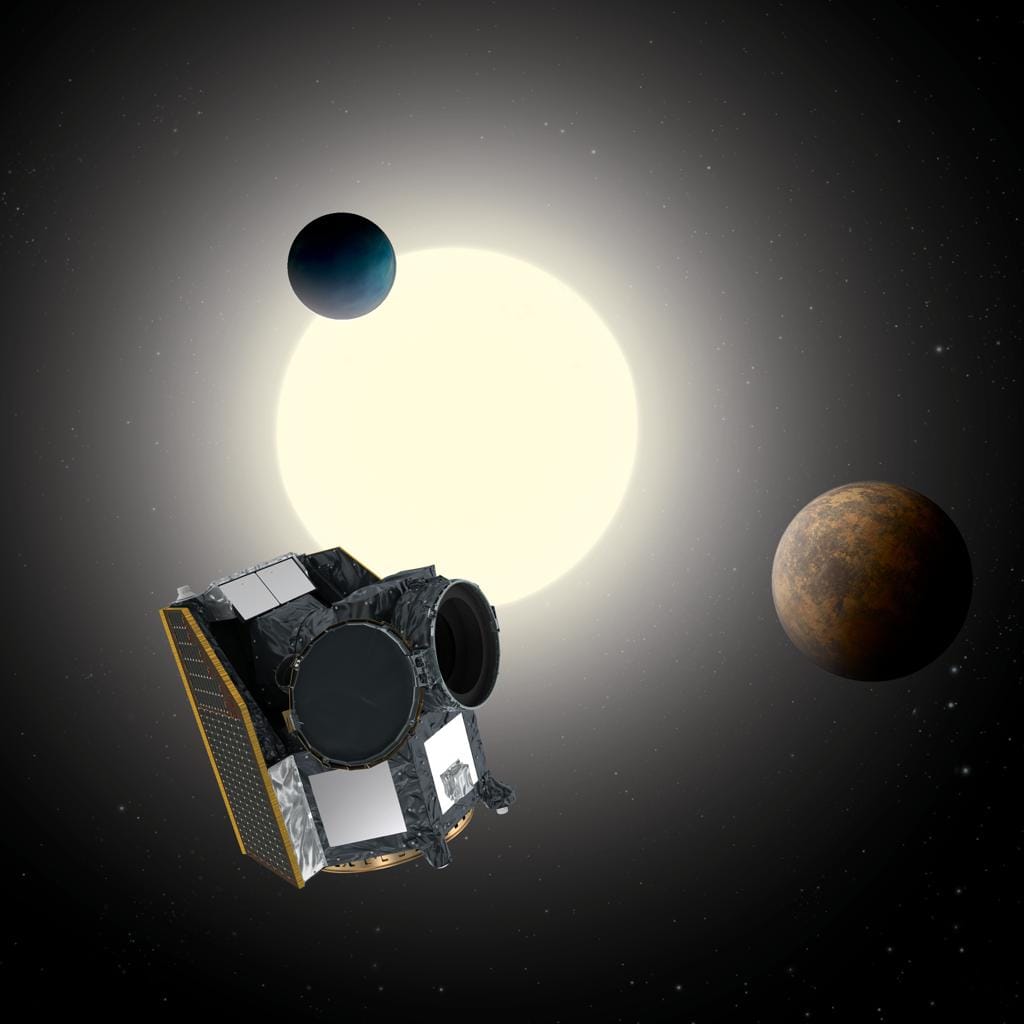

Swiss-Led CHEOPS Space Telescope Mission Extended by Three Years
The European Space Agency (ESA) has approved a further extension of the CHEOPS space telescope mission, allowing it to continue operating for an additional three years.
The decision follows a previous extension granted in 2023 and was confirmed by the scientific committee responsible for ESA missions, according to the Universities of Geneva and Bern.
Swiss Leadership in Space Research
CHEOPS (Characterising Exoplanet Satellite) was developed by a European consortium led by the University of Bern in collaboration with ESA. Since its launch in December 2019, the telescope has been dedicated to studying planets outside our solar system.
The mission is controlled from the University of Geneva, which operates its ground-based control centre and manages scientific operations.
Key Discoveries About Exoplanets
During its mission, CHEOPS has already contributed to several important discoveries in planetary science.
These include the identification of a highly deformed exoplanet shaped more like a rugby ball than a sphere, caused by extreme tidal forces from its host star.
The telescope has also contributed to research challenging existing theories on planetary system formation, including observations of unusual orbital arrangements around distant stars.
ESA Extends Multiple Space Missions
Alongside CHEOPS, ESA has also extended 12 additional space missions whose scientific phases were due to end in 2026.
These include major international projects such as the James Webb Space Telescope, Hubble Space Telescope, Mars Express, Solar Orbiter, and XMM-Newton.
Switzerland plays an active role in many of these missions through technology contributions, scientific collaboration, and operational support, particularly within ESA-led programs.
Only in some cases, such as Hubble and Einstein Probe, is Switzerland’s involvement limited mainly to financial participation and data access.
Strengthening Europe’s Space Science Future
The extension of CHEOPS reinforces Europe’s commitment to long-term space exploration and exoplanet research.
Swiss universities continue to play a central role in advancing astronomical research, contributing expertise that supports global efforts to understand distant planetary systems.