

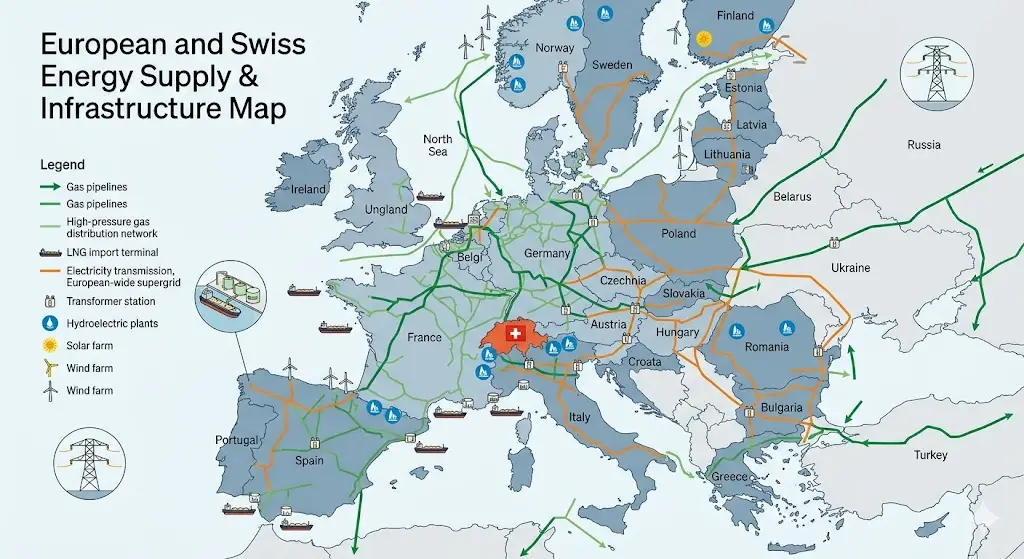

Iran Conflict Raises Concerns Over Swiss Gas and Electricity Supply.
The ongoing conflict involving Iran and growing tensions around the Strait of Hormuz are increasing concerns about energy security in Switzerland ahead of the winter season.
According to Swiss Federal Electricity Commission, the situation could affect Switzerland’s electricity supply and create uncertainty in European gas and electricity markets.
Energy experts warned that gas-fired power plants remain essential for maintaining electricity stability across Europe, especially during winter periods when energy demand rises sharply.
However, European gas storage levels are currently lower than expected, raising concerns about whether reserves can be fully replenished before winter begins.
ElCom stated that the war in Iran and the possibility of disruptions in the Strait of Hormuz — one of the world’s most important oil and gas shipping routes — could significantly impact global energy supplies.
Despite these risks, current gas and electricity prices remain below the extreme levels seen during the 2021–2022 European energy crisis.
Officials explained that Europe now has greater flexibility because liquefied natural gas (LNG) import capacity has expanded significantly in recent years.
In addition, France’s nuclear energy production is currently operating at unusually strong levels, helping stabilize regional electricity supplies.
Still, Swiss authorities warned that energy risks remain if the Strait of Hormuz faces a prolonged closure, if European gas storage remains insufficient, or if Europe experiences an exceptionally cold winter.
The report highlights how geopolitical conflicts in the Middle East continue to influence European energy markets, fuel security, and electricity supply planning.
Switzerland, although not a direct gas producer, depends heavily on European energy networks and imported energy resources during colder months.