

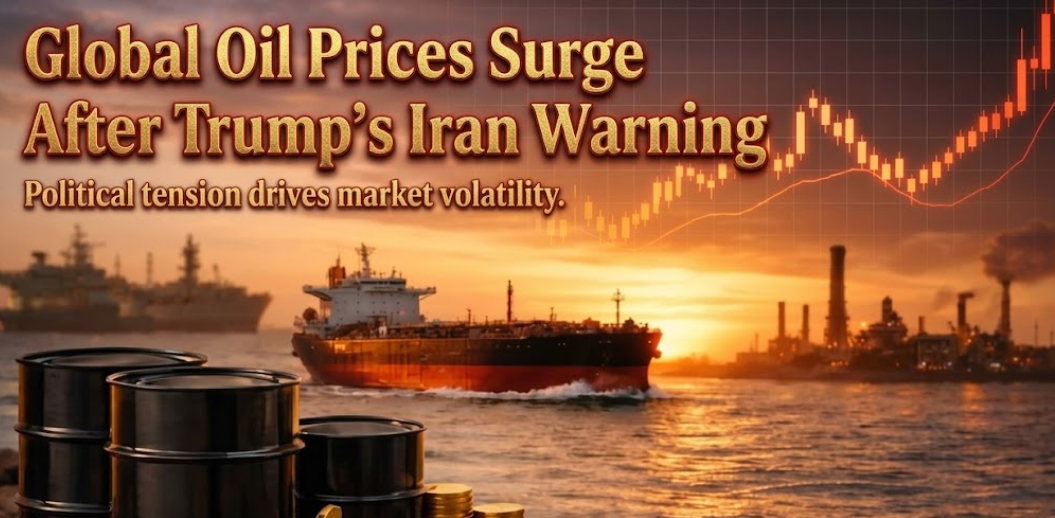

Global Oil Prices Surge After Trump’s Iran Warning.
Global Oil Prices Surge After Trump’s Iran Warning
Global crude oil prices have been increased again following remarks delivered by Donald Trump regarding tensions involving Iran.
As a result, uncertainty has been created in international energy markets. Consequently, investors have reacted cautiously to possible supply disruptions.
Supply Concerns Linked to Strait of Hormuz
Market expectations that restrictions affecting the Strait of Hormuz could soon be eased were weakened after the speech.
This narrow shipping route is considered extremely important because nearly 20% of global energy demand is transported through it. Therefore, any disruption in this region is closely monitored by global markets.
As a result, oil supply concerns were strengthened further after the warning statements were delivered.
Brent Crude Oil Prices Increased by 4%
Before the presidential speech began, the price of Brent crude oil had been recorded at 100 US dollars per barrel.
During the speech, price fluctuations were observed in the global market. However, by the end of the trading session, the price had increased by nearly 4%, reaching approximately 105.38 US dollars per barrel.
Therefore, renewed investor concern about supply chain risks has been reflected in the price movement.
Investors React to Escalating Political Warnings
Strong warnings regarding possible leadership changes in Iran and threats involving infrastructure damage were highlighted during the speech.
As a result, additional risks to the global oil supply chain were anticipated by investors. Consequently, analysts have indicated that these concerns contributed directly to the recent price increase.
Furthermore, continued geopolitical uncertainty in the region is expected to influence global energy markets in the coming weeks.
Global Economic Impact Closely Monitored
Because the Strait of Hormuz plays a vital role in global oil transportation, developments in the region are being closely monitored by economic observers worldwide.
Therefore, further price volatility is expected if geopolitical tensions remain unresolved.
As a result, global markets are likely to remain sensitive to future political developments affecting energy supply routes.